
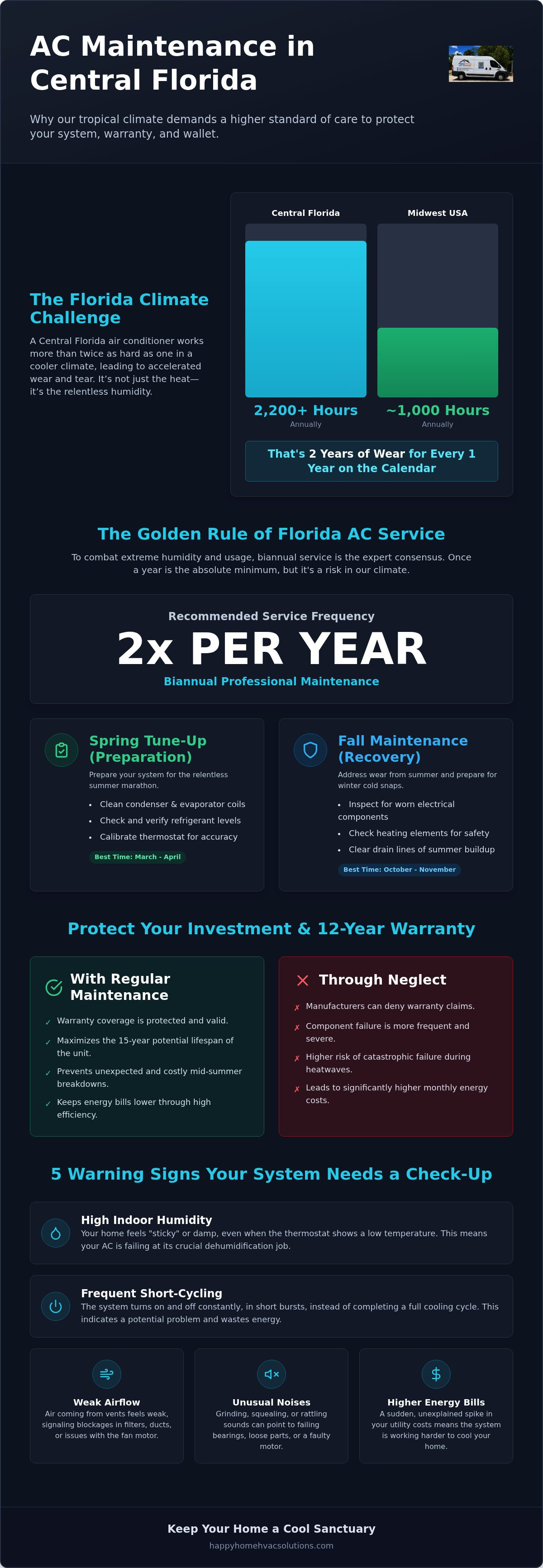
Did you know a Central Florida air conditioner works over 2,200 hours every year? That is roughly double the workload of a system in the Midwest, essentially putting two years of wear on your unit for every single calendar year that passes. When your system is running nearly 24/7 to combat our local humidity, it is easy to wonder if your current maintenance routine is actually enough to prevent a mid-summer breakdown.
We understand the stress of opening a high utility bill or worrying about the fine print in a warranty you have not looked at in years. You deserve to feel confident that your home will stay a cool sanctuary without overpaying for energy. This 2026 guide explains exactly how often service AC in Florida is necessary to protect your equipment and your wallet. We will walk you through the ideal maintenance schedule for our tropical climate, how to maximize the 15 year lifespan of your unit, and what the latest Florida warranty laws mean for your peace of mind. By the end, you will have a clear plan to keep your home comfortable and your cooling costs under control.
Key Takeaways
- Learn why Central Florida’s high humidity and 2,200+ annual run-hours put your system under twice as much stress as units in other regions.
- Understand how often service AC in Florida is actually necessary to keep your home comfortable and your monthly energy bills low.
- Discover how regular, documented maintenance protects your 12-year installation warranty and prevents costly coverage denials.
- Identify the subtle warning signs, such as indoor "stickiness" or frequent short-cycling, that signal your unit needs professional attention.
- See why a comprehensive spring tune-up is the best way to ensure your system can handle the relentless 90-degree summer marathon.
Why Florida’s Humidity Demands More from Your AC
Living in Central Florida means our air conditioners never truly get a vacation. While homeowners in the North might turn their systems off for several months at a time, units in Orlando and Sanford are often running year-round. This constant operation is the primary reason why neighbors often ask how often service AC in Florida is actually required. The relentless heat isn't the only culprit; it's the combination of high temperature and extreme moisture that creates a perfect storm for mechanical fatigue.
The 2,500-Hour Rule for Orlando Homeowners
Research shows that Florida systems run for more than 2,200 cooling hours a year. In many local households, especially in older homes in Lake Mary or Winter Springs, that number often climbs closer to 2,500 hours. Compare this to a state like Ohio, where a unit might only run for 1,000 hours. Your system is essentially aging twice as fast as the national average. This high volume of work leads to component fatigue in capacitors, fan motors, and compressors. Mechanical wear happens much faster here because the system rarely reaches a state of rest. Without regular attention, these parts don't just wear out. They tend to fail during the hottest week of July when the system is under maximum stress.
Moisture Removal: The Silent Job of Your AC
Most people think of their unit solely as a way to lower the indoor temperature. However, the true complexity of Heating, ventilation, and air conditioning (HVAC) systems in Florida lies in dehumidification. When outdoor humidity levels consistently stay above 70%, your evaporator coils must work double duty to pull gallons of water out of the air every single day. If your system isn't tuned to handle this moisture load, your home starts to develop that "sticky" feeling, even if the thermostat says it's 72 degrees. Proper moisture removal is essential for maintaining your home's air quality and preventing that heavy, humid atmosphere.
This excess moisture creates a uniquely local problem known as the "Biological Toll." Algae and slime thrive in the dark, damp environment of your condensate drain lines. In our tropical climate, these blooms can grow rapidly and clog your system, often leading to unexpected water damage in your ceiling or floors. Additionally, Central Florida’s heavy seasons for oak pollen create a thick, sticky blanket on your filtration system and outdoor coils. This debris restricts airflow and forces the motor to work harder, which drives up your monthly utility bills. When you consider these environmental factors, it becomes clear how often service AC in Florida is necessary to protect the sanctuary of your home and keep your equipment running efficiently.
The Golden Rule: How Often Should You Service Your AC in Florida?
While homeowners in other climates might get away with a checkup every other year, the standard for our region is much higher. The expert consensus for Central Florida residents is that professional maintenance should happen twice a year. This biannual approach ensures your system remains reliable during the 90-degree summer marathon and stays efficient enough to keep your power bills manageable. If you are wondering how often service AC in Florida is truly required for a newer system, once a year is the absolute bare minimum, but even then, you are taking a risk with our local humidity levels.
Spring tune-ups are about preparation. We focus on cleaning coils and checking refrigerant levels before the heat becomes relentless. Fall maintenance is equally vital but often overlooked. After running for thousands of hours during a Florida summer, your system needs a recovery check. We look for worn components that are on the verge of failing and verify that your heating elements are ready for the occasional cold snap that hits Oviedo and Altamonte Springs in January. This recovery visit prevents small issues from turning into major repairs during the off-season.
The Best Times of Year to Schedule in Central Florida
Timing your service call can make a significant difference in your overall comfort. March and April are the "sweet spots" for Orlando residents. By scheduling early, you avoid the frantic summer rush that begins in June when systems across the state start failing simultaneously. Including your HVAC check in a broader seasonal maintenance checklist helps ensure your home is fully prepared for the changing weather. Proactive scheduling means you won't be stuck waiting for a technician during a record-breaking heatwave when demand is at its peak.
Service Frequency Based on System Age
The age of your unit also dictates your specific maintenance needs. If you have a brand new system, following the strict standards of an LG certified HVAC contractor Florida is essential for keeping your 12-year warranty valid. Manufacturers often require documented annual or biannual service to honor parts replacements. For systems between 5 and 10 years old, biannual checks become non-negotiable as parts naturally begin to show signs of wear. If you are maintaining a legacy system that is over a decade old, these visits are your best defense against a total system replacement. Regular care can help you squeeze every remaining year of life out of an older unit, providing much-needed peace of mind. If you haven't had a professional look at your unit recently, consider exploring a maintenance plan to stay ahead of the heat.
Maintenance vs. Neglect: Protecting Your 12-Year Warranty
Many homeowners view a manufacturer's warranty as an unconditional promise. In reality, most warranties contain a "Service Clause" that requires documented, professional maintenance to remain valid. If a major component like a compressor fails, the manufacturer may ask for service records from the last few years. Without proof of regular care, they can classify the failure as "neglect" and deny your claim. This is a critical factor when deciding how often service AC in Florida is necessary for your specific home.
At Happy Home HVAC Solutions, our 12 year HVAC warranty Florida offers incredible peace of mind, but it relies on that same partnership of consistent care. We keep detailed records of every visit, ensuring you have the documentation needed to protect your investment. Neglect isn't just about letting a system break; it's about failing to provide the preventative attention that high-performance machinery requires in our harsh climate. Manufacturers expect you to treat your HVAC system like a vehicle that needs regular oil changes to stay under warranty.
The SEER2 Efficiency Gap
Efficiency isn't just a buzzword; it's a direct reflection of your monthly budget. When dirt and grime build up on your coils, your system has to work much harder to transfer heat. This buildup can drop your operating efficiency by as much as 30%. In 2026, the industry uses SEER2 (Seasonal Energy Efficiency Ratio 2) to measure how much cooling a system provides per watt of electricity used under updated, more rigorous testing conditions. A serviced unit maintains its SEER2 rating, while an unserviced one forces you to pay for performance you aren't actually receiving. The result is a "sticky" home and a higher bill.
Repair Costs vs. Maintenance Fees
Scheduled maintenance is always more affordable than a crisis. We frequently see emergency calls in Winter Springs and Oviedo for issues like blown capacitors or failed fan motors that a technician would have spotted months earlier. By choosing a proactive schedule, you avoid the stress of "after-hours" fees and the anxiety of a hot house on a Saturday night. Beyond the immediate savings, consistent care is the most effective way to add 3 to 5 years to your system's total lifespan. When you consider the long-term ROI, the question of how often service AC in Florida becomes a simple matter of protecting your home's sanctuary and your financial well-being.
5 Warning Signs Your System Needs a Check-Up Now
Florida’s heat is relentless, but your air conditioner usually gives you a heads-up before it quits completely. Recognizing these subtle signals can save you from a stressful breakdown in the middle of a July afternoon. If you find yourself wondering how often service AC in Florida is actually necessary because your home just doesn't feel right, these five indicators suggest you need professional attention immediately.
- Indoor Stickiness: If your home feels clammy even when the air is blowing, your system is failing to remove moisture. As we discussed earlier, dehumidification is just as important as cooling in our climate.
- Short-Cycling: When your unit turns on and off every few minutes, it never completes a full cooling cycle. This puts massive strain on the compressor and sends your energy usage soaring.
- Utility Bill Spikes: An unexplained jump in your Orlando Utilities Commission (OUC) or Duke Energy bill is a classic sign of an efficiency gap. If your habits haven't changed but your costs have, your system is likely struggling.
- Odd Odors: Musty smells usually point to biological growth, while a metallic or ozone scent often indicates an electrical component is overheating.
- Visible Ice: Seeing frost on your refrigerant lines in 90-degree weather is never normal. It usually points to a significant airflow restriction or a refrigerant leak that requires professional tools to fix.
The "Dirty Sock Syndrome" and Florida Air Quality
That musty, vinegar-like smell coming from your vents is often called "dirty sock syndrome." It's caused by bacteria and algae building up on your evaporator coils, which thrive in our 70% plus humidity. Professional coil cleaning doesn't just remove the odor; it eliminates the biological growth that can trigger allergies or respiratory discomfort for your family. Maintaining clean coils is a vital part of ensuring your home remains a healthy sanctuary, especially during the peak pollen seasons in Oviedo and Winter Springs.
Noises You Should Never Ignore
Your AC should operate with a steady, predictable hum. If you start hearing high-pitched squealing, it often points to a slipping fan belt or a motor under duress. Grinding or metal-on-metal sounds are even more urgent, as they usually indicate that bearings have failed and a motor is about to seize. A persistent clicking sound at the thermostat or the outdoor unit often means an electrical contactor is struggling to engage. If your system is making these sounds, it's best to turn it off immediately and schedule an ac repair oviedo to prevent a small mechanical issue from turning into a total system replacement. Staying ahead of these warnings is the best way to maintain your peace of mind and keep your cooling costs under control.
Peace of Mind with Happy Home HVAC Maintenance Plans
Our approach at Happy Home HVAC Solutions is built on a simple foundation: professional reassurance combined with neighborly warmth. We don't just see a mechanical system; we see the heart of your home's comfort. While the environmental data makes it clear how often service AC in Florida is necessary, actually keeping up with that schedule can be a challenge for busy families. That is why our maintenance plans are designed to take the guesswork out of the process. We act as your proactive partner, ensuring your system is ready for the heat before the first humidity spike of the season hits.
For our neighbors in Altamonte Springs and Winter Park, being a maintenance member means you never have to worry about being left in the heat. Members receive priority service, which is a significant advantage during the peak summer months when every HVAC company in the state is backed up. Additionally, as an LG Certified contractor, we provide specialized expertise for those utilizing high-efficiency mini-split systems. This certification ensures that your advanced equipment is serviced to the exact manufacturer standards required to maintain peak performance and warranty eligibility.
Our Multi-Point Inspection Checklist
A Happy Home HVAC Solutions tune-up is far more than a quick visual check. We perform a methodical evaluation of your entire system to ensure every component is operating at its design efficiency. Our comprehensive process includes:
- Refrigerant and Electrical Analysis: We verify refrigerant levels and tighten all electrical connections to prevent the short-cycling and component failure mentioned in previous sections.
- Condensate Drain Clearing: We deep-clean your drain lines to prevent the biological growth that causes "dirty sock syndrome" and the dreaded Florida ceiling flood.
- Thermostat Calibration: We ensure your thermostat is communicating accurately with your unit for maximum precision and lower energy consumption.
Join the Happy Home HVAC Solutions Family
Local homeowners trust us for HVAC repair Winter Springs FL because they know we stand behind our workmanship with honesty and transparency. We aren't interested in one-time transactions; we value long-term relationships that keep your home a cool, comfortable sanctuary year after year. By joining our family of maintenance members, you are investing in the longevity of your system and the daily peace of mind that comes with reliable cooling. Scheduling your first 2026 seasonal check-up is the most effective way to lower your utility bills and protect your 12-year warranty. Let us handle the technical details so you can focus on enjoying your home.
Secure Your Home's Comfort for the Seasons Ahead
Maintaining a cool home in Central Florida shouldn't be a source of stress. By now, you understand that our unique climate turns standard maintenance into a vital necessity for your comfort and your budget. Following a biannual schedule is the most effective way to lower your monthly utility bills and ensure your 12-year warranty remains fully protected. Whether you're noticing the early warning signs of "sticky" indoor air or simply want to avoid the frantic summer rush, being proactive is the best way to preserve your system’s health. Knowing how often service AC in Florida is required gives you the power to prevent expensive breakdowns before they ever start.
As a family-owned and locally operated business, we take pride in being your trusted expert guide. Our team provides expert service across Orlando, Oviedo, and Lake Mary, bringing the precision of an LG Certified HVAC Contractor to every home we visit. We're here to restore your peace of mind and keep your sanctuary comfortable all year long. Schedule your seasonal AC tune-up with Happy Home HVAC today! We look forward to welcoming you into our family and helping you enjoy a worry-free summer.
Frequently Asked Questions
How often should I change my AC filter in Florida?
You should change your AC filter every 30 to 90 days, depending on the type of filter you use. However, because our systems run over 2,200 hours annually, checking it every month is the best practice for Orlando homeowners. A dirty filter restricts airflow, which forces your motor to work harder and can lead to frozen coils. If you have pets or suffer from allergies, a fresh monthly filter is essential for your home's air quality.
Is biannual AC service really necessary for brand new units?
Yes, biannual service is necessary even for brand new systems to maintain peak efficiency and protect your investment. Most manufacturers require documented professional maintenance to keep your parts warranty active. By starting a consistent schedule early, you ensure that small factory defects or installation adjustments are handled before they cause long-term damage. This proactive care helps your new unit reach its full 15 year potential while keeping your monthly cooling costs as low as possible.
What happens if I skip my annual AC maintenance?
Skipping maintenance often leads to a gradual decline in cooling performance and a steady increase in your energy bills. Without regular cleaning, dirt builds up on the evaporator coils, reducing heat transfer and causing the system to run longer cycles. Over time, this neglect leads to preventable repairs like blown capacitors or clogged drain lines. You also risk losing your manufacturer warranty coverage, which can turn a simple fix into a major out of pocket expense.
Can I perform AC maintenance myself to save money?
You can certainly help your system by changing filters and keeping the outdoor unit clear of debris like oak leaves or grass clippings. However, a professional tune-up involves technical tasks like checking refrigerant pressures, testing electrical components, and deep-cleaning internal coils. These steps require specialized tools and training to perform safely. Attempting DIY repairs on internal components can accidentally damage your system or even void your 12-year installation warranty and compromise your home's safety.
How long do AC units typically last in the Central Florida climate?
In the Central Florida climate, a well-maintained AC unit typically lasts between 10 and 15 years. The extreme humidity and high run-times mean our systems age much faster than those in cooler states. Regular professional care is the single most important factor in reaching that 15 year mark. Without it, many units begin to fail prematurely around year 8 or 9 due to component exhaustion or internal corrosion from the high moisture and tropical environment.
Does AC maintenance help lower my monthly electric bill?
Professional maintenance directly impacts your wallet by restoring your system's operating efficiency. When your coils are clean and your refrigerant levels are precise, the unit doesn't have to run as long to reach your desired temperature. This reduces the total kilowatt-hours your home consumes each month. Many homeowners find that the energy savings from a properly tuned system help offset the cost of the service itself while providing much better humidity control for your family.
Will skipping service void my 12-year HVAC warranty?
It is very likely that skipping professional service will void your warranty. Most manufacturers specify that the warranty only covers parts if the system has been maintained according to their guidelines. If you need to file a claim for a major part like a compressor, the manufacturer may require proof of service. Documenting how often service AC in Florida is performed is your best insurance against denied claims and the stress of unexpected repair costs.
What is the best month to schedule AC service in Orlando?
The best months to schedule your spring service in Orlando are March and April. Scheduling during this window ensures your system is ready before the intense summer heat arrives in June. It also allows you to avoid the peak season rush when technicians are busiest with emergency repairs. Knowing how often service AC in Florida should occur helps you plan your home maintenance calendar effectively to ensure year-round comfort and sanctuary for your entire family.


