
The biggest AC unit isn’t automatically the best choice for a Florida home. If it isn’t matched to your home’s layout and cooling needs, you may still have uneven temperatures or sticky indoor air. The best AC system for Florida climate is one that can handle the heat and humidity while fitting your home.
Choosing between central AC, a heat pump, and ductless mini-splits can feel complicated, especially when you’re also weighing system size and features. The right fit depends on more than the unit itself: your ductwork, room layout, and comfort priorities all matter.
This guide compares the main system types and explains which home layouts they may suit. You’ll also learn why proper sizing matters, what to ask an HVAC contractor, and how to consider humidity control and consistent comfort in Central Florida. Whether you’re in Orlando, Oviedo, Winter Springs, Winter Park, or Altamonte Springs, this information can help you compare options for your home.
Key Takeaways
- The best AC system for Florida climate depends on your home’s layout, ductwork, cooling needs, and humidity concerns, not simply the unit’s capacity.
- Compare central AC, heat pumps, and ductless mini-splits by considering which rooms need cooling and whether you want separate temperature control in different areas.
- A high efficiency rating or larger system alone doesn’t guarantee comfort. Ask how the proposed equipment matches your home’s cooling load.
- Before reviewing proposals, note uneven temperatures, humidity concerns, room use, duct condition, and any planned renovations.
- Ask your HVAC contractor to explain the sizing process, system options, and installation details so you can evaluate each recommendation with confidence.
What makes the best AC system for Florida climate a good fit for your home?
Florida homeowners need more than cool air on a hot afternoon. Indoor spaces should feel comfortable rather than clammy, and the system needs to handle local conditions without being oversized for the home.
Choosing an AC system means matching its capacity, controls, and setup to the home’s cooling load, ductwork, and comfort needs. The best AC system for Florida climate isn’t necessarily the biggest unit or the one with the most features. A home-specific assessment helps identify equipment suited to the home and its comfort priorities.
Why humidity control matters alongside cooling
An air conditioner cools indoor air as it passes over a cold coil. Moisture in the air can condense on the coil and drain away, so the system may cool and remove some moisture at the same time. For a simple overview of how systems cool indoor spaces, see Air conditioning.
A cool thermostat reading doesn’t always mean a room feels comfortable. If the air feels clammy, the equipment may not be removing moisture effectively under the home’s conditions. Sizing, controls, airflow, and installation all influence how a system operates. Ask a qualified HVAC professional how the proposed setup addresses both temperature and humidity concerns. Don’t assume a particular unit guarantees a specific result.
Why Central Florida homes can have different cooling needs
Two homes in the Orlando area can face the same outdoor weather and still need different cooling setups. Home size matters, but so do shade, window area and exposure, insulation, air leakage, occupancy, and heat from appliances or other equipment. A sunny room with large windows, for example, may warm faster than a shaded room elsewhere in the same house.
Local climate provides context, not a capacity recommendation. A contractor should assess the individual home and its existing system, including duct condition where applicable, before recommending equipment size. Avoid choosing a unit based only on square footage or replacing existing equipment with the same capacity without asking how the home’s cooling needs were evaluated.
When discussing options, describe where temperatures feel uneven, when rooms feel damp, and whether room use or renovation plans may change. Those details help shape a recommendation around how your household lives, not just a number on the thermostat.
How central AC, heat pumps, and mini-splits differ in Florida
These systems can all cool a Florida home, but they distribute air differently and suit different layouts. A heat pump can provide both cooling and heating. Central AC and heat pumps may use ductwork, while a mini-split delivers conditioned air without ducts. The best AC system for Florida climate depends on how your home is built and which rooms need attention.
| System | Typical fit | Ductwork | Zoning potential | Questions to verify |
|---|---|---|---|---|
| Central split AC | Homes with an existing duct system and a layout suited to central air distribution. | Requires ducts. | May be possible with compatible controls and system design. Confirm what the proposal includes. | Are the ducts in good condition and properly suited to the home? |
| Central heat pump | Homes seeking one system for cooling and heating. | Often uses ducts, though system configurations vary. | Depends on the equipment, controls, and duct design. | How will it provide heating as well as cooling, and what controls are included? |
| Ductless mini-split | Additions, rooms without ducts, or spaces where separate temperature control is a priority. | Doesn’t require ducts to distribute air to its indoor units. | Can serve selected areas. Confirm how many zones the design supports. | Where will indoor units go, and does the design suit the room layout? |
When central air conditioning may suit a home
Central AC can be a practical option if your home already has serviceable ductwork and its layout supports air distribution throughout the house. Existing ducts aren’t automatically a good fit, though. Their condition, size, and design can affect how evenly air reaches rooms. Ask for an inspection and discuss any hot or stuffy spots. Equipment type alone doesn’t determine room-to-room comfort.
When a ductless mini-split may be worth comparing
A mini-split may be worth considering for a converted garage, an addition, or another space that lacks ducts or needs separate control. Its suitability depends on the room arrangement, equipment design, and your priorities. It isn’t automatically more efficient or better for every home. For more layout considerations, read this Orlando ductless mini-split installation guide.
If efficiency ratings are part of your comparison, review ENERGY STAR’s air-source heat pump guidance and ask which ratings apply to the specific equipment being proposed. Happy Home HVAC Solutions installs AC systems and mini-splits in Central Florida. Discuss AC installation options that fit your home and comfort priorities.
Is a high-efficiency or larger AC system always better for Florida?
No. A large capacity rating or high efficiency label can look appealing, but neither proves that a system suits your home. The best AC system for Florida climate fits the home’s cooling needs and is installed to operate as intended. An oversized system may reach the thermostat setting quickly and shut off before running long enough to remove moisture effectively. The exact effects depend on the equipment, controls, and home, so ask a qualified HVAC professional how the recommendation addresses your comfort concerns.
How proper sizing supports comfort
Choose equipment capacity based on a home-specific cooling-load assessment, not floor area alone. A contractor can use Manual J, a recognized method for estimating a home’s heating and cooling load, as part of evaluating the appropriate system size. The assessment considers factors such as windows, insulation, shade, and how the home is used. Ask how the load was calculated and whether the proposal accounts for rooms that run warmer or feel more humid. A rule based only on square footage can miss important differences between homes.
How to compare efficiency without assuming savings
SEER2 means Seasonal Energy Efficiency Ratio 2. It’s an efficiency rating that helps compare cooling equipment under standardized test conditions. A higher rating can indicate greater tested efficiency, but it doesn’t predict exactly how much a household will use or save. Actual electricity use depends on operating patterns, the home’s cooling needs, equipment fit, and installation quality.
For a fair comparison, check the complete equipment specifications and compare like with like, such as systems of the same type and relevant capacity. Confirm that the figures apply to the proposed combination of indoor and outdoor equipment, and use current, verified specifications. Ask your contractor to explain the trade-offs in plain language. Your utility bill history and provider’s information can help you understand your household’s usage, but neither guarantees a particular result from a new system.
Efficiency and sizing are only part of a sound decision. Review the written warranty separately. Check what components and work it covers, how long coverage lasts, and any conditions that apply. Happy Home HVAC Solutions notes that up to a 12-year warranty is available on many installations, but terms and eligibility should be confirmed for the specific proposal. This Florida HVAC warranty guide can help you understand what to review before choosing.
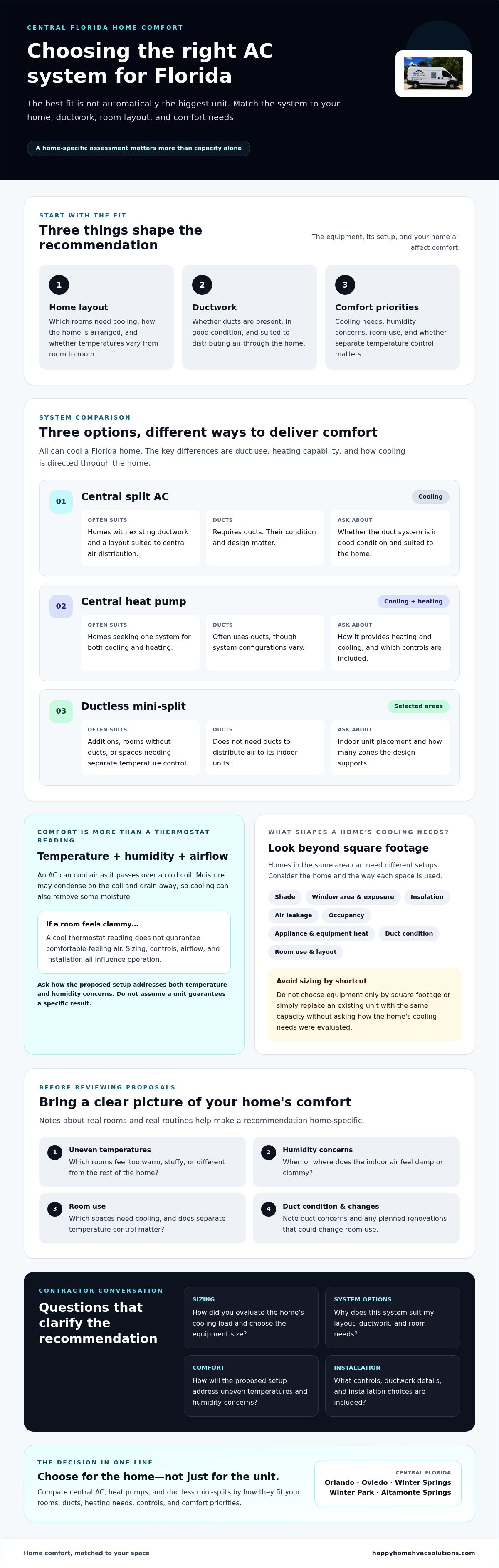
How to choose the right AC system for your Florida home
A clear selection process turns comfort complaints into useful information for an HVAC assessment. Use these steps to compare options for your home, not just equipment labels.
- List the comfort issues. Note rooms that run warmer, times when indoor air feels humid or clammy, and whether the problem is constant or seasonal. Share how you use each room and how many people are typically home.
- Ask about the ducts. If your home has central air, have the duct system inspected rather than assuming it’s suitable because it’s already there. Ask whether its condition and design may contribute to uneven airflow.
- Review the home’s cooling load. Ask how the contractor will assess the home’s needs, including windows, shade, insulation, and internal heat sources. Mention planned renovations, additions, or changes in how rooms will be used.
- Compare suitable system types. Discuss central AC, a heat pump, or ductless mini-splits based on your layout, ductwork, heating needs, and preference for room-by-room control. Ask what trade-offs led to each recommendation.
- Review the full proposals. Compare the equipment and work included, controls, any duct-related work, startup or system checks, and warranty terms. If recommendations differ substantially or remain unclear, consider getting another professional opinion.
What to ask during an AC system assessment
Good questions help you understand the reasoning behind a recommendation. Ask: How will you assess the home’s cooling load and room-by-room comfort needs? What did you find when checking the ductwork? Which system types could fit, and what are their trade-offs? Which current efficiency ratings, equipment specifications, and applicable codes should I consider? A contractor should be able to explain the answers in language you can follow.
Tell the assessor about uneven temperatures, humidity concerns, how often specific rooms are used, and future renovation plans. Also ask what maintenance the proposed system requires and what the installation warranty covers, including exclusions and conditions. Compare written terms rather than relying on a headline duration.
How the home’s envelope fits into the decision
Insulation and other features that separate indoor and outdoor conditions can affect the home’s cooling needs. If your attic insulation is part of the concern, this Orlando attic insulation installation guide offers related context. Include known insulation issues in the assessment so the contractor can account for the home as it is and discuss any planned improvements.
Ready to review system options for your home? Discuss AC installation options with Happy Home HVAC Solutions, serving Central Florida.
Choosing and installing an AC system with a Central Florida HVAC professional
Equipment selection and installation belong in the same decision. A system that looks suitable on paper still needs to be matched to the home and installed according to its specifications. Before moving ahead, understand what equipment is proposed, what work is included, and how the installer will check that the system is operating as intended.
Happy Home HVAC Solutions is a family-owned, licensed HVAC company serving Central Florida. The company installs AC systems and mini-splits and is LG certified. Up to a 12-year warranty is available on many installations, but eligibility, coverage, and other terms depend on the installation and should be confirmed in writing.
What professional installation planning should clarify
Ask the contractor to explain the selected system and why it fits your home. The written scope should identify the equipment and specifications, any included duct-related work, the controls, and the checks or commissioning steps planned after installation. If anything is unclear, ask for clarification before approving the proposal.
Review warranty documents separately from the equipment recommendation. Confirm what’s covered, how long coverage applies, what conditions or exclusions may affect it, and whether any maintenance expectations apply. Understand the maintenance requirements for the proposed system so you can plan for its care. Clear written details make it easier to compare proposals and understand what you’re agreeing to, without relying on assumptions about coverage or future performance.
A practical next step for Orlando-area homeowners
If you live in Orlando, Lake Mary, Sanford, Oviedo, Winter Springs, Winter Park, or Altamonte Springs, prepare a few notes before discussing your options. Include rooms that feel uneven, humidity concerns, how you use different spaces, information about existing ducts, and plans for additions or renovations. Bring questions about system sizing, controls, equipment specifications, installation scope, and warranty terms.
A careful conversation can help connect those details to a system recommendation without rushing the decision. For homeowners considering the best AC system for Florida climate, professional guidance can clarify which options fit the home and what the installation involves. Talk with Happy Home HVAC Solutions to discuss your home’s needs and request a professional assessment.
Choose a system that fits your home
The best AC system for Florida climate isn’t simply the largest or the one with the highest efficiency rating. It’s the system selected for your home’s layout, cooling needs, ductwork, and comfort priorities. Central AC, heat pumps, and mini-splits may each suit different situations, while proper sizing and installation matter alongside equipment choice.
As you compare options, explain any uneven temperatures or humidity concerns, ask how the system’s capacity was determined, and review the proposed controls, installation scope, and warranty conditions. A clear recommendation should explain why the setup suits your home.
Happy Home HVAC Solutions is a family-owned, licensed HVAC company serving Central Florida and is LG certified. Up to a 12-year warranty is available on many installations. Ask about the applicable terms for your specific proposal. To discuss your home’s needs and system options, contact Happy Home HVAC Solutions about the right AC system for your home.
Frequently Asked Questions
Is a heat pump a good choice for Florida?
Yes, a heat pump may suit a Florida home if you want one system that can provide both cooling and heating. Whether it’s appropriate depends on the home’s cooling load, existing equipment and ductwork, and heating needs. Ask a licensed HVAC professional to compare it with other options that fit your property. For homes in Orlando, Oviedo, or nearby Central Florida communities, a home-specific assessment is more useful than choosing by system type alone.
What type of AC system works best in Florida humidity?
No single system type guarantees the best humidity control in every home. Central AC and ductless systems can both cool a home, but their suitability depends on layout, sizing, controls, and installation. Ask how the proposed system is expected to remove moisture under your home’s conditions and what factors may affect its operation. The best AC system for Florida climate is selected for your home’s needs, not simply by equipment category.
Is a bigger air conditioner better for a Florida home?
Not necessarily. The system should match your home’s cooling load, not just its square footage or a preference for more capacity. Oversizing can affect operating cycles and comfort, though the specific impact depends on the home and equipment. Ask the contractor how they assessed the load and why they recommend that capacity. Request a clear explanation of the assessment and how it accounts for your home’s conditions.
Are ductless mini-splits worth considering in Florida?
Yes, mini-splits may be worth comparing for additions, rooms without ducts, or spaces where separate temperature control would be useful. They aren’t automatically the best fit for every home. Consider the room layout, existing ductwork, comfort priorities, equipment design, and proposed installation plan. A homeowner in Winter Park or Altamonte Springs, for example, can ask a qualified HVAC professional how a ductless option would serve the specific rooms being considered.
What does SEER2 mean when choosing an AC system?
SEER2 is an efficiency rating used to compare eligible air-conditioning equipment under a defined testing method. It can help you compare suitable options, but it doesn’t predict your household’s exact energy use or guarantee a particular utility bill. Check current specifications for the equipment being proposed and compare relevant system types. Also consider system sizing, installation quality, controls, and how your household uses cooling.
How do I know what size AC system my home needs?
A qualified contractor should assess your home’s cooling load rather than rely on a basic square-footage rule. The assessment may account for windows, insulation, shade, occupancy, heat from appliances, and existing ductwork. Ask what method was used, what assumptions were included, and how the recommendation addresses rooms with different comfort needs. Sharing details about warm rooms, humidity concerns, and planned renovations can help the professional understand how you use your home.
Should I repair my current AC or replace it with a new system?
It depends on the equipment’s condition, repair history, comfort performance, and the work needed. A professional assessment can explain repair and replacement options without assuming you need a new system. Ask for the findings, the scope of any proposed work, and applicable warranty details in writing. Happy Home HVAC Solutions provides AC repair and installation in Central Florida, including Orlando, Oviedo, Winter Springs, Winter Park, and Altamonte Springs.


