
A heavy-duty air conditioner blasting cold air can still leave your living room feeling like a damp swamp. In our subtropical climate, simply dropping the temperature isn't enough to solve sticky indoor air or curb punishing summer electric bills. When weighing Lennox vs Trane vs LG for Florida homes, the real decision comes down to how effectively each system wrings out moisture while handling relentless, months-long operating cycles.
You shouldn't have to live with a clammy thermostat reading of 72 degrees, nor should you lose sleep over corrosive humidity causing premature breakdowns and expensive replacement delays. You deserve dependable, quiet comfort that protects your home without draining your wallet. In this 2026 comparison, you'll discover how Lennox, Trane, and LG measure up across humidity control, real-world energy efficiency, and coastal durability in Central Florida. We examine the engineering strengths, inverter compressor performance, and long-term warranty options across each brand, giving you the clear insights needed to choose the ideal cooling system for your sanctuary.
Key Takeaways
- Latent heat removal matters more than raw cooling power; discover why variable-speed inverter technology is essential for eliminating indoor clamminess.
- When evaluating Lennox vs Trane vs LG for Florida homes, your decision hinges on balancing peak SEER2 energy savings, durable condenser coil designs, and ductwork flexibility.
- Uncover how specialized coil materials and corrosion-resistant coatings shield outdoor compressors against Central Florida's brutal humidity and salt-laden air.
- Learn how your home's layout, duct condition, and ceiling heights dictate whether a traditional central split or a multi-zone mini-split will perform best.
- Find out why precision installation sizing and certified manufacturer warranties, including coverage up to 12 years, provide lasting peace of mind.
The Florida Climate Challenge: Key Criteria for Evaluating HVAC Brands
Central Florida tests cooling systems unlike almost anywhere else in the country. Between Orlando and Sanford, air conditioners don't just tackle triple-digit heat indexes; they also battle relentless humidity that saturates building materials and challenges your comfort. When evaluating Lennox vs Trane vs LG for Florida homes, choosing equipment based solely on raw horsepower will leave you disappointed. Success requires balancing moisture extraction, verified electrical efficiency, and protective coil construction.
To ensure a system protects your home's indoor air quality and runs reliably for years, look for three essential design benchmarks:
- Dedicated latent capacity: The system must pull moisture out of the air continuously rather than just dropping the thermostat quickly.
- High SEER2 performance: Verified seasonal efficiency ratings protect household budgets during ten straight months of cooling.
- Corrosion-resistant condenser coils: Robust coil engineering prevents airborne moisture and coastal salinity from creating pinhole refrigerant leaks.
Moisture Management: Sensible vs. Latent Cooling in Florida
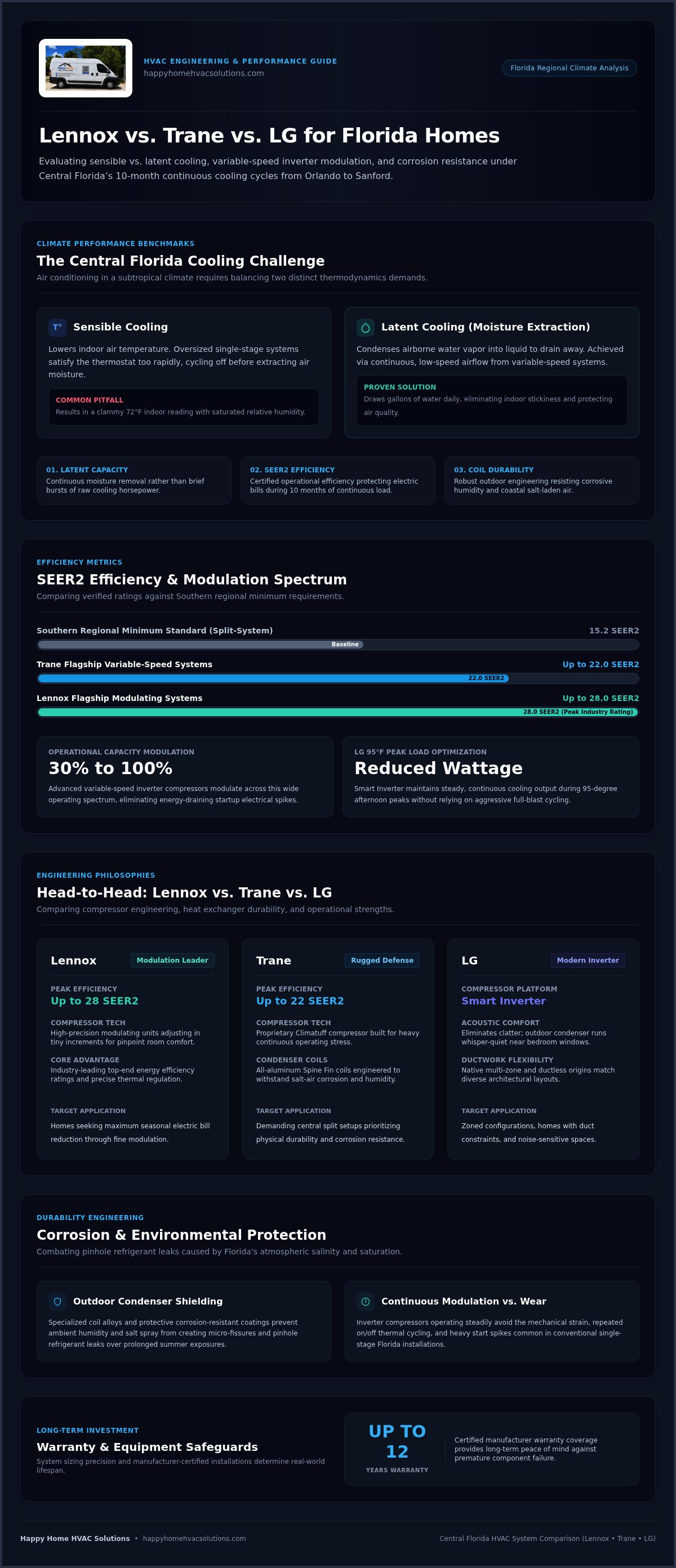
Cooling involves two distinct jobs: sensible cooling (lowering the indoor air temperature) and latent cooling (condensing airborne water vapor into liquid to drain away). Looking back at the early history of air conditioning, the original industrial systems were actually engineered to control moisture rather than drop room temperatures. Oversized single-stage systems cool a room too fast. They shut off before pulling moisture across the indoor coil, leaving indoor air feeling muggy and cold. Continuous, low-speed airflow from variable-speed equipment remains the gold standard, drawing gallons of water from the air each day to eliminate indoor stickiness.
Energy Efficiency Realities Under Year-Round Cooling Demands
Southern regional standards mandate a minimum efficiency rating of 15.2 SEER2 for split-system air conditioners, reflecting the intense seasonal workload across Florida. Upgrading to advanced variable-speed inverter compressors allows the system to modulate its capacity between 30% and 100%, matching daily temperature swings without wasting electricity on repeated startup spikes. If you pair that variable-speed precision with the thermal boundary insights in our attic insulation guide for energy efficiency, your equipment won't have to fight intense attic radiant heat. Making an informed choice between Lennox vs Trane vs LG for Florida homes starts with recognizing that true efficiency comes from balanced, extended operation, not sudden bursts of full blast cooling.
Brand Comparison: Lennox vs Trane vs LG Performance Head-to-Head
Evaluating Lennox vs Trane vs LG for Florida homes highlights three distinct engineering philosophies. While traditional brands often rely on legacy ducted frameworks, modern inverter-driven designs prioritize dynamic speed control to keep comfort steady and electric meters quiet.
Compressor Engineering and Operational Modulation
Trane builds its reputation on the rugged Climatuff compressor, pairing it with all-aluminum Spine Fin outdoor coils to handle intense physical strain. Lennox focuses on high-precision modulating units that step up or down in tiny increments for precise temperature maintenance. LG takes a modern approach with its Smart Inverter technology. Originating from ductless and multi-zone designs, LG compressors adjust continuously to exact thermal loads. They eliminate the harsh clatter of older equipment, running so quietly that you barely notice the outdoor condenser operating outside your bedroom window.
Real-World Efficiency Ratings and Florida Power Consumption
Lennox leads peak efficiency ratings with flagship models reaching up to 28 SEER2, while Trane's top variable-speed units deliver up to 22 SEER2. Both brands cut utility bills significantly compared to aged baseline systems. LG inverters shine during scorching 95-degree afternoon peaks by maintaining steady output at reduced wattage. This continuous run cycle avoids massive electrical startup spikes while balancing indoor air in line with ASHRAE ventilation standards for cleaner, healthier living spaces.
Parts Availability and Local Maintenance Considerations
Maintenance logistics vary across all three manufacturers. Trane enjoys deep regional distribution across Central Florida, meaning universal wear items like capacitors, contactors, and fan motors are readily stocked on local service trucks. Lennox relies more heavily on proprietary communicating electronic boards, which can occasionally create supply delays during busy summer peaks. LG uses streamlined modular components supported by expanding regional logistics networks. When weighing Lennox vs Trane vs LG for Florida homes, long-term dependability always comes down to proper service support. If you want an honest assessment of which platform fits your layout, connect with our friendly team for dependable AC installation advice tailored to your space.
Durability and Salt-Air Defense: How Each System Weathers Florida
Operating an air conditioner in Central Florida places severe physical demands on outdoor equipment. While inland systems typically achieve a 10 to 15-year operating lifespan, units exposed to coastal salt air can degrade and fail in as little as 5 to 7 years. Even in communities like Orlando, Oviedo, or Sanford, relentless moisture, summer downpours, and long run-times will quickly expose vulnerable metallurgy. Comparing Lennox vs Trane vs LG for Florida homes means looking past glossy marketing brochures to examine how each brand shields its outdoor condenser coils and sensitive circuit boards from environmental corrosion.
Coil Construction and Corrosion Vulnerability
Traditional outdoor condenser coils use copper tubing laced through aluminum fins. When exposed to damp, salt-laden air, this pairing triggers galvanic reactions where dissimilar metals meet, corroding the aluminum and sparking microscopic refrigerant leaks. Manufacturers counter this threat with different engineering strategies:
- Trane Spine Fin coils: Built entirely from aluminum, this design eliminates dissimilar metal contact. The continuous, all-aluminum tubing and spun-fin surface resist galvanic corrosion and stand up exceptionally well to humid winds.
- Lennox Quantum coils: Lennox utilizes a proprietary all-aluminum alloy engineered specifically to resist salt spray degradation and oxidation compared to traditional copper coils.
- LG GoldFin technology: LG applies a specialized hydrophilic, anti-corrosive epoxy coating over its fin surfaces. This protective layer repels pooled water droplets, accelerates rain runoff, and prevents corrosive moisture from adhering to the outdoor metal.
Electronic Component Protection and Surge Vulnerability
Central Florida holds the reputation as the lightning capital of North America. Frequent summer electrical storms generate severe voltage surges that can easily destroy the complex inverter motherboards that regulate modern variable-speed equipment. Lennox shields its communicating controls inside heavy-gauge metal cabinets, though the sensitive electronic boards still face thermal stress during prolonged 95-degree heat. Trane encases its electronics securely within WeatherGuard panels, keeping heavy rain and yard debris out. LG protects its outdoor inverter modules by utilizing fully sealed, silicone-potted electronics enclosures, defending delicate microchips against humidity ingress, insects, and atmospheric oxidation. When weighing Lennox vs Trane vs LG for Florida homes, adding an inline whole-home surge protector remains an essential defense to ensure your investment stays protected against unpredictable power spikes.
Application Guide: Matching Equipment to Your Central Florida Home
Every neighborhood across Greater Orlando presents distinct architectural challenges. A single-story ranch built in the 1970s behaves entirely differently from a multi-story contemporary build with vaulted ceilings. When comparing Lennox vs Trane vs LG for Florida homes, your home's ductwork condition, square footage distribution, and thermal layout should determine which brand configuration belongs on your property.
Whole-Home Central Ducted Configurations
Newer subdivisions in Lake Mary or Sanford typically feature well-sealed, properly sized duct networks routed through conditioned or semi-conditioned spaces. In these floor plans, traditional central split systems from Trane or Lennox perform admirably. Lennox provides high seasonal efficiency ratings when paired with proprietary communicating thermostats, while Trane delivers consistent airflow volume across extensive trunk lines. However, older ductwork with unsealed joints or deteriorated insulation can waste up to 30% of conditioned air into your sweltering attic space. Review our comprehensive Sanford AC installation guide to evaluate whether your current ducts can support high-efficiency central split systems without compromising comfort.
Targeted Multi-Zone and Ductless Cooling
Historic properties in Winter Park, enclosed lanais, converted garages, and second-story bonus rooms often face persistent hot spots that central ducted systems struggle to cool. LG ductless heat pumps excel in these demanding scenarios by delivering conditioned air directly into individual living zones without traversing an attic that routinely tops 130 degrees. This targeted approach allows you to cool active rooms to 72 degrees while keeping unoccupied spaces at energy-saving settings. You can explore layout ideas, multi-zone options, and indoor unit styles in our Orlando ductless mini split installation guide.
Finding the right balance between Lennox vs Trane vs LG for Florida homes comes down to matching equipment capabilities directly to your living habits. If you are ready to eliminate muggy rooms and solve uneven temperatures across your floor plan, contact our local comfort specialists to schedule a detailed home layout assessment.
Warranty Coverage, Certified Installation, and Long-Term Value
A shiny brand badge cannot rescue an improperly sized or poorly installed system. In our punishing climate, the quality of your installation directly determines whether your equipment reaches its intended lifespan or fails years early. Sizing the unit accurately through room-by-room load calculations, brazing refrigerant lines under nitrogen, and properly charging the system protect your investment far more than manufacturer marketing. When assessing Lennox vs Trane vs LG for Florida homes, lasting satisfaction relies on certified installation craftsmanship backed by ironclad warranty protection.
Standard Factory Warranties vs. Certified Contractor Extensions
Most major manufacturers provide a base 5-year parts warranty if you don't register the equipment. Timely online registration extends standard factory parts coverage to 10 years for Lennox and Trane systems, with select premium Trane compressors eligible for 12-year protection. Uncertified installations or unlicensed handymen can jeopardize that coverage, leaving you stuck with expensive component repair bills. Because Happy Home HVAC Solutions holds official LG Certified HVAC Contractor status, we can deliver extended warranty protection up to 12 years on select systems. You can explore how long-term protection guards against unexpected component failures in our Florida 12-year HVAC warranty overview. Remember that all manufacturers require documented annual maintenance to keep registered warranties in good standing.
Making the Final Decision for Your Household Comfort
Each brand delivers specific advantages depending on your property's needs:
- Trane: Choose Trane if you have functional existing ductwork and prioritize proven mechanical durability through all-aluminum outdoor coils.
- Lennox: Select Lennox if you want class-leading peak SEER2 ratings and are willing to pair equipment with proprietary digital controls for precise efficiency.
- LG: Opt for LG if you want whisper-quiet inverter operation, advanced multi-zone ductless flexibility, and superior moisture removal without cycling spikes.
Resolving the debate of Lennox vs Trane vs LG for Florida homes shouldn't feel overwhelming. Our family-owned team takes pride in guiding our neighbors across Orlando, Oviedo, and Seminole County with honest, pressure-free recommendations tailored to your family's daily comfort and budget. Schedule your in-home comfort evaluation with Happy Home HVAC Solutions today, and let us restore true peace of mind to your sanctuary.
Choose the Perfect Cooling System for Your Sanctuary
Conquering Central Florida heat takes more than raw chilling power; it demands continuous moisture extraction, durable corrosion defense, and balanced energy consumption. When evaluating Lennox vs Trane vs LG for Florida homes, remember that your home's unique layout and duct condition matter just as much as the badge on the cabinet. Trane brings rugged coil reliability, Lennox delivers top-tier efficiency ratings, and LG offers whisper-quiet inverter modulation with pinpoint multi-zone comfort.
Whichever direction fits your lifestyle best, your investment relies on precision sizing and meticulous installation. As an official LG Certified HVAC Contractor, Happy Home HVAC Solutions pairs expert craftsmanship with eligible extended warranty coverage up to 12 years on select equipment. Our family-owned team lives right here in the community, proudly serving Orlando, Oviedo, and surrounding neighborhoods with honest, dependable care. Schedule your personalized cooling consultation with Happy Home HVAC Solutions today, and enjoy crisp, refreshing indoor comfort all year long.
Frequently Asked Questions
Is Trane or Lennox better suited for Central Florida humidity?
Both brands manage humidity well when equipped with variable-capacity compressors, but Trane holds a slight durability advantage in wet environments. Trane's all-aluminum Spine Fin coils resist corrosion from damp air, while Lennox variable-speed units excel at gradual modulation for steady latent moisture removal. In comparing Lennox vs Trane vs LG for Florida homes, your choice depends on whether mechanical coil toughness or ultra-precise humidity setting control matters most to you.
Why is LG becoming a popular cooling choice for Florida homes?
LG is gaining popularity because of its advanced inverter compressor technology and ductless multi-zone flexibility. Rather than cycling on and off at full blast, LG inverters run steadily at lower wattages to wring moisture out of the air continuously. Homeowners across Orlando and Winter Park appreciate their whisper-quiet outdoor operation, compact footprint, and the ability to eliminate hot spots without dealing with leaky attic ductwork.
What SEER2 rating should I choose for an air conditioner in Florida?
You should aim for at least 16 to 18 SEER2 for optimal balance between upfront investment and energy savings in Central Florida. While the Southeast regional baseline is 15.2 SEER2, our lengthy ten-month cooling seasons mean higher-efficiency units pay for themselves much faster. Stepping up to variable-speed systems rated at 18 SEER2 or above delivers superior dehumidification and shields your monthly budget against peak summer electric rates.
How does Florida salt air affect Lennox, Trane, and LG outdoor coils?
Salt air accelerates metal oxidation, often degrading traditional copper and aluminum coils within five to seven years. Trane combats this with seamless all-aluminum Spine Fin coils that eliminate galvanic corrosion. Lennox uses proprietary all-aluminum Quantum coils designed to resist environmental oxidation. LG protects its units with GoldFin hydrophilic coating, which sheets water away quickly to stop airborne salts from eating into the exterior cooling fins.
What is the warranty difference between standard installers and LG certified contractors?
Standard uncertified installers can only offer base manufacturer warranties, which typically cover parts for five to ten years after registration. Working with an official LG Certified HVAC Contractor unlocks extended coverage up to 12 years on select equipment. In communities like Oviedo and Lake Mary, that extended backing gives homeowners substantial peace of mind against costly component repairs throughout the grueling Florida cooling season.
Can a ductless mini-split system cool an entire Central Florida house?
Yes, multi-zone ductless heat pump systems can easily cool an entire home by connecting multiple indoor air handlers to a single outdoor inverter condenser. This setup bypasses unconditioned, superheated attic spaces entirely, eliminating standard duct losses. Each room receives independent temperature control, allowing you to prioritize occupied areas like bedrooms or living spaces while cutting electrical waste in unused zones across your household.
How long does a new air conditioning system typically last in Florida?
A new cooling system in Central Florida typically lasts between 10 and 15 years with diligent maintenance. However, proximity to coastal salt breezes, neglected air filter changes, or poor installation sizing can drop that lifespan to under 8 years. When weighing Lennox vs Trane vs LG for Florida homes, pairing quality equipment with precision installation and annual maintenance ensures your system achieves maximum operating longevity.


