
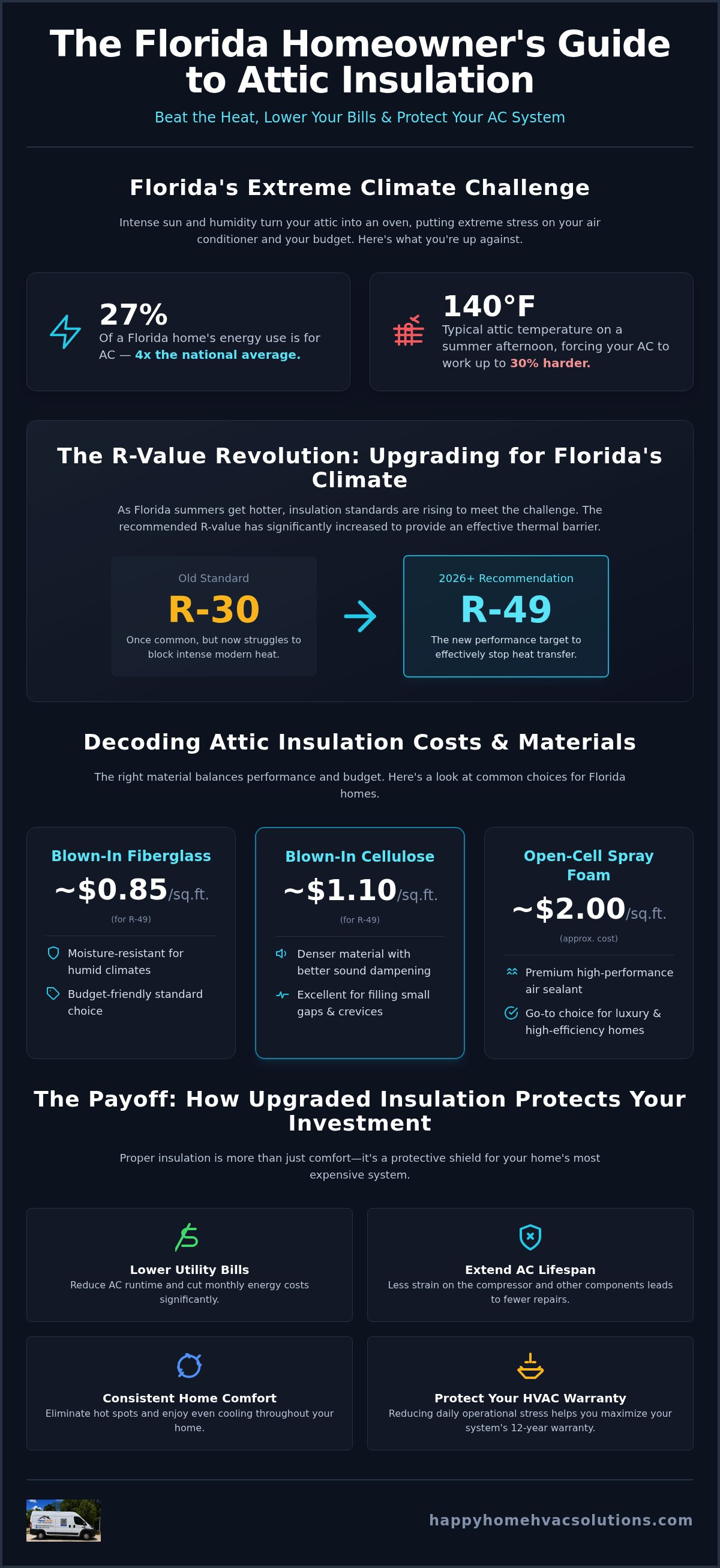
Did you know that air conditioning accounts for roughly 27% of the average Florida household's energy use? That is more than four times the national average. In 2026, much of that expensive cold air is likely escaping through your ceiling because of thin or degraded materials. If you've noticed your AC unit running constantly without a break, you're probably researching the current attic insulation cost Florida homeowners are seeing this year. It's a common concern for our neighbors in Orlando and Oviedo who want a home that stays cool without causing a monthly budget crisis.
We understand how frustrating it is to deal with uneven cooling and sky-high utility bills every summer. This guide will help you discover how modern insulation trends and updated Florida Building Code requirements impact your home's comfort and your long-term HVAC health. We'll preview the latest state-level rebates and explain how the right R-value can act as a protective shield for your air conditioner. By the end of this analysis, you'll have a clear path toward lower monthly bills, a longer-lasting AC system, and a consistently chilled home environment for your family.
Key Takeaways
- Learn how updated 2026 Florida building codes and R-value standards impact your home's ability to resist extreme attic temperatures.
- Compare common materials to find the best balance of performance and attic insulation cost Florida homeowners need to know before hiring a contractor.
- Find out why proper attic prep and air sealing are the most overlooked steps in preventing high utility bills and uneven cooling.
- Discover how upgraded insulation acts as a protective shield for your AC unit, reducing compressor strain and helping you maximize your system's 12-year warranty.
- Understand the benefits of an integrated efficiency approach that treats your attic and HVAC system as a single, high-performing unit.
The 2026 Florida Energy Climate: Why Attic Insulation Costs are Shifting
Living in Central Florida means dealing with a sun that turns your attic into a giant convection oven. On a typical July afternoon in Orlando or Oviedo, attic temperatures can easily soar to 140 degrees. This intense heat doesn't stay upstairs; it radiates downward, forcing your air conditioner to fight a losing battle. Understanding the attic insulation cost Florida families are navigating in 2026 starts with recognizing that your insulation is actually a mechanical component of your cooling system. It's the first line of defense for your comfort.
Thermal resistance in our region is the specific capacity of a material to block heat transfer while resisting the heavy humidity that characterizes Central Florida's atmosphere. For a long time, R-30 was considered the standard for most local homes. However, 2026 trends show a significant shift toward R-49. This change reflects a growing reality: as our summers get longer and hotter, old standards simply can't keep the heat out effectively anymore. Upgrading to a higher R-value creates a thick enough barrier to stop that 140-degree heat from reaching your living space.
Florida Building Codes and 2026 Efficiency Standards
Current residential requirements in Central Florida cities like Winter Park and Altamonte Springs are becoming more stringent. While the base code for vented attics has historically sat at R-30, many modern high-efficiency builds now target R-38 or R-49 to meet Department of Energy (DOE) recommendations for Climate Zone 2. Understanding the science of Building insulation is vital because it explains why higher R-values are necessary to combat the radiant heat specific to our latitude. Homeowners are increasingly choosing higher-performance materials to stay ahead of these rising standards and ensure their homes remain efficient and easy to cool.
The Cost of Inaction: Rising Utility Rates in Central Florida
When your insulation is thin or settled, your AC unit has to work significantly harder to maintain a steady temperature. Industry data suggests that poor attic protection can force a cooling system to work up to 30% harder than necessary. This extra strain leads directly to the "AC unit running constantly" problem many of our neighbors experience, which can lead to premature wear on your equipment. In 2026, we are seeing a major trend where homeowners choose to "top off" their existing insulation. This is a practical, cost-effective way to close the gap between old R-19 levels and the modern R-49 standard. By addressing this now, you prevent the monthly power bill spikes that happen when your attic heat wins the tug-of-war against your air conditioner. It's also a proactive way to protect your system and honor your 12-year HVAC warranty by reducing daily operational stress.
Decoding Attic Insulation Cost in Florida: Material Trends
Choosing the right material is the biggest variable when calculating the attic insulation cost Florida homeowners should expect to pay. In 2026, the market has matured beyond basic fiberglass batts. We now see a distinct split between budget-friendly blown materials and high-performance spray foams. Each has a specific role in maintaining your home's comfort and your HVAC system's longevity. The physical layout of your attic and your specific cooling goals will ultimately dictate which material provides the best return on your investment.
Blown-In Cellulose and Fiberglass: The Budget-Friendly Standards
Blown-in materials remain the standard for most ranch-style homes in Orlando. Blown fiberglass is highly valued for being naturally moisture-resistant; this is essential in our humid environment. Research shows it typically costs around $0.85 per square foot for an R-49 rating. Cellulose is another popular option. It is denser than fiberglass and provides slightly better sound dampening, generally running about $1.10 per square foot for R-49. These materials are excellent for retrofitting older homes because they fill small gaps and crevices that traditional batts might miss. According to EPA energy saving estimates, properly sealing and insulating your attic is one of the most effective ways to lower annual utility expenses.
Spray Foam Insulation: The Premium 2026 High-Performance Choice
For luxury homes in Lake Mary or Winter Park, spray foam has become the go-to premium choice. Open-cell spray foam costs approximately $2.20 per square foot for R-49 and offers an integrated air seal that blown materials cannot match. Closed-cell foam is even more robust, coming in at roughly $5.65 per square foot for R-49. This material is incredibly dense and acts as a vapor barrier; it is often the preferred choice for unvented attic designs. While the initial investment is higher, the superior air sealing properties dramatically reduce the load on your air conditioner, helping you avoid those mid-summer system failures.
A growing 2026 trend is the hybrid approach. This involves using spray foam to seal critical air leaks and then topping the rest of the attic with blown-in fiberglass. This strategy balances high-performance sealing with a manageable budget. You should also keep in mind that labor costs in Florida reflect the difficulty of the job. Working in 140-degree heat requires specialized safety gear and precise attention to detail to ensure the material is applied at the correct density. If you're ready to see which material fits your budget and home layout, we can provide a transparent insulation services quote that focuses on your long-term savings and comfort.
Hidden Cost Factors: What Drives Your Final Insulation Quote?
Many homeowners are surprised to find that the attic insulation cost Florida contractors quote includes more than just the raw material. A high-quality installation requires significant preparation to ensure the new material actually performs as promised. When you receive a quote, you're paying for a comprehensive service that addresses the unique challenges of our humid, high-heat environment. Cutting corners on prep work often leads to degraded performance and higher utility bills just a few years down the line.
You can't simply throw fresh fiberglass or cellulose over old, settled material and expect modern efficiency. If your current insulation is contaminated by pests or has suffered water damage from past Central Florida storms, complete removal is necessary. This step ensures a clean slate and prevents mold or odors from being trapped under the new layer. Additionally, labor fees are influenced by your home's architecture. A steep roof pitch or a cramped attic with limited crawling space makes the job more physically demanding and time-consuming for the crew. Baffle installation is critical for Florida roof ventilation because it keeps the fresh air intake from your soffits clear and prevents the new insulation from blocking vital airflow.
Air Sealing: The Most Important 'Extra' You Need
Air sealing is the most important "extra" you need for a truly efficient home. Without it, your expensive AC-cooled air will continue to leak into the attic through small gaps around can lights, electrical wires, and plumbing stacks. Think of insulation like a wool sweater and air sealing like a windbreaker; you need both to stay protected from the elements. We often find that sealing these "hidden" leaks is what finally stops the uneven cooling between rooms that many families in Orlando and Oviedo struggle with during the summer.
Ventilation and Radiant Barriers
Your attic needs to "breathe" to prevent moisture buildup, which is a constant threat in our humid climate. Solar fans or ridge vents help regulate the thermal profile of the space, ensuring that heat doesn't remain trapped against your roof deck. In 2026, many homeowners are also opting for radiant barriers to reflect the intense Florida sun. While these additions might increase the upfront attic insulation cost Florida families pay, they significantly extend the lifespan of your roof and reduce the workload on your HVAC system. Ensuring proper airflow is the best way to prevent the moisture and mold issues that can arise when an attic is sealed too tightly without a ventilation plan.
Calculating ROI: How Insulation Protects Your HVAC Investment
When you evaluate the attic insulation cost Florida homeowners encounter, it's helpful to view it as a protective down payment on your air conditioning system. In our climate, an under-insulated attic acts like a thermal weight that your AC has to carry every single day. By upgrading your insulation, you're effectively reducing the cycle times of your compressor. Instead of starting and stopping constantly, or running for hours just to maintain 75 degrees, your system can reach its target temperature quickly and stay there. This efficiency is the most reliable way to honor your 12-year HVAC warranty by preventing the mechanical burnout caused by extreme heat infiltration.
The payback period for these upgrades is often shorter than most people expect. With cooling costs making up about 27% of a Florida power bill, a 15% to 25% reduction in energy use can save hundreds of dollars annually. Beyond the monthly savings, you're avoiding the "hidden" costs of premature system failure. A well-insulated home keeps the attic heat from migrating into your ductwork, ensuring that the air coming out of your vents is actually as cold as the thermostat demands. This creates a more consistent home environment while keeping your most expensive appliance in peak condition.
Extending the Life of Your Air Conditioner
An insulated attic is truly the best defense against frequent AC repair in Sanford, FL. When heat penetrates the ceiling, your unit enters an "overwork" state where electrical components and fan motors are pushed to their limits. This mechanical wear is what leads to those mid-July breakdowns that every homeowner dreads. If you've recently invested in a new AC installation in Sanford, matching that high-efficiency unit with the proper R-value insulation ensures you get the full lifespan out of your investment. It's about creating a balanced environment where your technology isn't fighting against your home’s architecture.
2026 Tax Credits and Florida Rebates
While the federal 25C tax credits expired at the end of 2025, the 2026 savings landscape has shifted toward state and utility programs. For example, Duke Energy currently offers up to $800 for attic insulation upgrades, while FPL provides a $220 instant rebate for qualifying customers. We are also keeping a close eye on Florida's HEAR and HOMES rebate programs, which can provide up to $1,600 for insulation and air sealing for income-qualified residents. To maximize these benefits, it's vital to keep all contractor invoices and material specifications. If you're ready to see how these savings can lower your attic insulation cost Florida investment, we can help you schedule an efficiency audit to identify every available rebate for your project.
The Happy Home HVAC Approach: Integrated Efficiency Solutions
At Happy Home HVAC Solutions, we believe that your insulation and your air conditioner should work in perfect harmony. Many general contractors treat insulation as a standalone building material; however, as licensed HVAC experts, we see it as a vital part of your cooling cycle. When we analyze the attic insulation cost Florida families are considering, we look at the big picture. Our goal is to ensure your home remains a sanctuary where the air stays cold and the utility bills stay manageable. We don't just blow in material and leave. We ensure your system can breathe and perform at its peak.
Being a family-owned business in Central Florida means we treat every project with neighborly care and professional precision. We aren't interested in just selling you more material. Instead, we're interested in a "Whole-Home" philosophy. This integrated approach ensures that your insulation doesn't just block heat but also supports the specific airflow and containment needs of your AC unit. It's the most effective way to provide peace of mind and protect your 12-year HVAC warranty by reducing the daily strain on your compressor.
Our Professional Attic Assessment Process
We use advanced diagnostic tools to identify the thermal gaps that a standard visual inspection might miss. Our team looks for signs of settled material, bypasses around your ductwork, and areas where moisture might be compromising your current setup. Because we are an LG-certified contractor, we understand the technical requirements for modern high-efficiency systems. We provide a straightforward, honest evaluation that matches your home’s age with the most effective R-value upgrades for your specific floor plan. You'll receive a clear explanation of our findings without any confusing technical jargon.
Ready for a Cooler Home? Next Steps
Improving your home’s comfort shouldn't be a stressful experience. When you're ready to get a transparent, neighborly breakdown of the attic insulation cost Florida projects require, our process is designed to be simple and efficient. We offer detailed efficiency audits for our neighbors in Oviedo, Winter Springs, and Altamonte Springs. During our visit, we prioritize your comfort and provide actionable solutions.
- Detailed measurements of your current insulation depth and R-value.
- Identification of critical air leaks and ventilation blockages near your soffits.
- A clear, written quote that prioritizes long-term energy savings.
On the day of your installation, our professional crew arrives on time and works with precision to ensure every corner of your attic is protected. We take great pride in our workmanship and treat your home with the respect it deserves. Join the Happy Home family today and let us help you restore your home’s comfort while giving your HVAC system the break it needs to last for years to come.
Secure Your Home’s Comfort and Efficiency for 2026
Investing in your attic is about more than just a one-time home improvement project; it's a long-term strategy to protect your home’s sanctuary. By moving toward modern R-49 standards and addressing those critical air leaks we discussed, you significantly reduce the mechanical load on your air conditioner. This proactive step helps you manage the attic insulation cost Florida summers demand while extending the life of your expensive HVAC equipment. It's the most effective way to ensure your indoor environment stays consistently cool even when the outdoor heat is relentless.
As an LG Certified HVAC Contractor and a family-owned business, we bring Central Florida expertise to every audit. Our "Whole-Home" approach ensures your insulation works to support our 12-year warranty on select installations, rather than leaving your system to struggle alone. We're here to provide the transparent guidance and professional precision you deserve. Schedule Your Energy Efficiency Audit with Happy Home HVAC Solutions today to start your journey toward lower utility bills. Let’s work together to restore your peace of mind and keep your family comfortable for years to come.
Frequently Asked Questions
How much does attic insulation cost for a 2,000 sq. ft. home in Florida?
The total investment for a 2,000 square foot home depends largely on the material you choose and the current condition of your attic. Blown-in fiberglass or cellulose is typically the most budget-friendly option for larger homes in Orlando compared to premium spray foam. Factors like the need for old insulation removal or professional air sealing will also influence the final attic insulation cost Florida homeowners see on their quotes. We focus on providing transparent breakdowns for every project.
What is the best type of insulation for the Central Florida climate?
Blown-in fiberglass and open-cell spray foam are two of the most effective choices for our humid environment. Fiberglass is naturally moisture-resistant and won't settle as easily as other materials; making it a reliable standard for Oviedo attics. Spray foam offers superior air sealing which is excellent for high-performance homes. We often recommend a hybrid approach to balance performance and budget; ensuring your HVAC system doesn't have to fight against radiating roof heat every afternoon.
Does attic insulation really lower my AC bill in Orlando?
Yes; upgrading your attic insulation can lead to 15% to 25% savings on your monthly cooling costs. In a city like Orlando where summer temperatures are extreme; insulation acts as a thermal barrier that keeps cold air inside your living space. This prevents your air conditioner from running non-stop; which reduces energy consumption. It also protects your AC unit from mechanical wear; helping you avoid expensive repairs during the peak of the Florida summer season.
Can I install attic insulation myself to save on costs?
While DIY kits are available; professional installation is recommended to ensure the material reaches the correct R-value and density. Incorrectly installed insulation can block soffit vents; leading to moisture buildup and mold issues in your attic. As a licensed HVAC contractor; we also perform critical air sealing that most homeowners miss. Professional handling ensures your project meets the 2026 Florida Building Code and helps maintain the integrity of your HVAC system's long-term warranty.
How do I know if my Florida home needs more insulation?
You should check your attic if you notice uneven temperatures between rooms or if your AC runs constantly without reaching the target temperature. A quick visual check can also help; if you can see your floor joists; you likely don't have enough material. In Central Florida; we look for at least 15 to 20 inches of insulation to meet modern R-49 standards. An efficiency audit is the most accurate way to identify hidden thermal gaps in your ceiling.
Are there tax credits for attic insulation in 2026?
Federal tax credits under Section 25C expired at the end of 2025; but several Florida-specific rebates remain available in 2026. Utility providers like Duke Energy and FPL offer incentives that can significantly offset the attic insulation cost Florida families pay for upgrades. Additionally; state programs like HEAR and HOMES provide rebates for income-qualified residents who demonstrate measured energy reductions. We always recommend checking with your local utility provider for the most current rebate amounts before starting.
How long does it take to install new insulation in an attic?
Most professional attic insulation projects in Central Florida are completed within a single day. A standard top-off or blown-in installation typically takes four to six hours depending on the size of your home and the accessibility of the attic space. If your project requires the removal of old; contaminated material or extensive air sealing; it may take a bit longer. Our team prioritizes an efficient; clean process so your family's daily routine isn't disrupted.
Will new insulation help with the humidity inside my house?
Proper insulation combined with air sealing is very effective at reducing indoor humidity. By closing the gaps where hot; moist attic air leaks into your home; your air conditioner can more effectively dehumidify your living space. This creates a much more comfortable environment and prevents the "clammy" feeling often associated with high Florida humidity. It also reduces the strain on your AC's evaporator coil; which promotes a healthier and more consistent indoor climate for your family.


