
Have you ever considered that a more powerful air conditioner might actually make your house feel less comfortable? It sounds backward, but in our unique climate, installing an oversized system is one of the most expensive mistakes a homeowner can make. When it comes to choosing the right AC unit size for Florida home, bigger is rarely better. If your system is too large, it will cool the room temperature so quickly that it never has a chance to pull the moisture out of the air. This leaves you with a home that feels like a cold, damp swamp rather than the sanctuary you deserve.
We know how frustrating it is to watch your electric bills climb while your indoor air stays humid and heavy. You want a home that is a reliable escape from the heat, not a source of stress and frequent breakdowns. This 2026 guide will help you master the science of cooling capacity so you can achieve lower monthly costs and a dry environment. We will explore how professional load calculations work, why local expertise in areas like Altamonte Springs and Winter Springs is vital, and how the perfect fit ensures your equipment lasts for up to 15 years.
Key Takeaways
- Learn why cooling capacity is about more than just square footage, especially when balancing temperature and humidity in Central Florida.
- Discover how a professional Manual J Load Calculation identifies the precise AC unit size for Florida home by evaluating windows, insulation, and air leaks.
- Avoid the high costs of "short cycling" by understanding why oversized units lead to frequent breakdowns and higher utility bills.
- Identify how local environmental factors, such as attic R-values and window efficiency, directly impact your system's required BTU output.
- Gain peace of mind with expert installation standards that ensure your system remains efficient and reliable for up to 15 years.
Why Square Footage is Only Half the Story in Central Florida
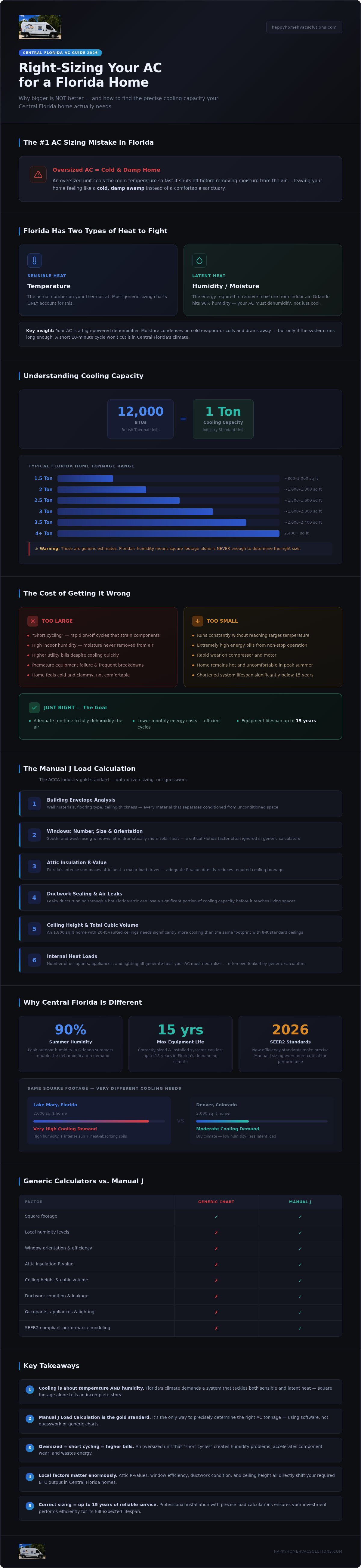
Selecting the right AC unit size for Florida home requires more than just a floor plan. Many homeowners assume that if they have 1,500 square feet, they simply buy the unit labeled for that size. In our part of Central Florida, that logic often leads to a sticky house and high energy bills. Cooling a home involves two distinct types of heat: sensible and latent. Sensible heat is the actual temperature you see on your thermostat. Latent heat, however, is the energy required to remove moisture from your indoor air. Our local climate is a battle against both.
We measure cooling capacity in BTUs (British Thermal Units). In the HVAC industry, 12,000 BTUs equal one "ton" of cooling. While tonnage tells us how much heat a unit can move, it doesn't tell us how efficiently it handles the thick, humid air of an Orlando summer. If your system is sized only for the square footage, it may satisfy the thermostat while leaving your family uncomfortable.
The Role of Humidity in Comfort
Your air conditioner is actually a high-powered dehumidifier. As warm air passes over the cold evaporator coils, moisture condenses and drains away. If your system is sized only for the temperature, it might cool the room in ten minutes and shut down. This leaves the air feeling clammy because the unit didn't run long enough to pull out the water. Latent heat is the energy required to remove moisture. When the humidity hits 90% in Orlando, your system has to work twice as hard to keep you comfortable, even if the thermometer says it is only 75 degrees inside.
Tonnage vs. Square Footage: A Florida Reality Check
Standard industry charts often fail us because they don't account for the local environment. A 2,000 square foot home in Lake Mary faces a completely different challenge than the same house in a dry climate like Denver. Precision is everything. Relying on a neighbor's advice or a generic online calculator is a recipe for trouble. Your home’s specific needs depend on several factors:
- The number and orientation of your windows.
- Your current attic insulation levels.
- How well your ductwork is sealed against the heat.
Getting the AC unit size for Florida home right means looking at the whole picture. An incorrectly sized system won't just leave you uncomfortable; it will wear out its components years before it should. We focus on finding the exact balance to keep your home dry and your utility bills manageable.
Calculating Tonnage: The Manual J Load Calculation Standard
Precision is the cornerstone of a comfortable home. While some contractors still use "back of the envelope" math or simple square footage charts, these methods often lead to expensive mistakes. To find the exact AC unit size for Florida home, professionals rely on the Manual J Load Calculation. This protocol, developed by the Air Conditioning Contractors of America (ACCA), is the industry gold standard. It uses specialized software to account for every factor that affects how heat enters and leaves your house. By the time we reach 2026, the transition to SEER2 standards has made this precision even more vital, as modern equipment is designed to operate within very specific performance windows.
Relying on old-school rules of thumb can leave you with a system that struggles to keep up or one that cycles on and off too frequently. Modern software allows us to model your home's thermal performance with incredible accuracy. This ensures that the tonnage we recommend isn't just a guess; it's a data-driven solution tailored to your specific living space.
What Goes Into a Professional Load Calculation?
A true load calculation analyzes the entire "building envelope." This includes the materials used in your walls, the type of flooring you have, and the thickness of your ceilings. We also look at internal loads, which are often overlooked by generic calculators. Your appliances, the number of people living in the home, and even the type of lighting you use all generate heat that your AC must neutralize.
Ceiling height is another critical variable. A 1,800 square foot home with standard eight-foot ceilings requires significantly less cooling capacity than the same footprint with vaulted, twenty-foot ceilings. The software calculates the total cubic volume of air, ensuring the tonnage is sufficient to move and cool that entire mass of air effectively. If you're feeling unsure about your current system's performance, a professional assessment for AC installation in Sanford, FL can provide the clarity you need.
Tonnage Guide: A Starting Point for Florida Homeowners
Residential air conditioners are typically sized between 1.5 and 5 tons. To understand these numbers, remember that one ton of cooling equals 12,000 BTUs (British Thermal Units) per hour. While this range provides a baseline, your specific AC unit size for Florida home will likely fall somewhere in the middle based on your home's unique characteristics.
- 1.5 to 2 Tons: Common for smaller homes or townhouses under 1,200 square feet.
- 2.5 to 3.5 Tons: The typical range for average-sized family homes in Central Florida.
- 4 to 5 Tons: Required for larger estates or homes with significant heat gain from windows and high ceilings.
Determining your exact needs is the first step toward long-term peace of mind. We invite you to reach out to our team for a detailed evaluation of your home’s cooling requirements to ensure your next system is a perfect fit.
The Cost of Getting it Wrong: Oversized vs. Undersized Units
Many homeowners believe that buying a larger unit provides a safety net against the intense Florida sun. This "bigger is better" mentality is actually the most common mistake we see in Central Florida. An oversized system cools your home too quickly, leading to a phenomenon called short cycling. This occurs when the unit turns on and off in rapid succession because it reaches the thermostat setting before it can complete a full cooling cycle. Choosing the wrong AC unit size for Florida home doesn't just waste energy; it creates a chain reaction of mechanical and environmental issues that can shorten your system's life by years.
When a system is sized incorrectly, you lose the peace of mind that comes with a reliable home sanctuary. Whether the unit is too large or too small, the result is the same: higher costs and less comfort. It's also a risk to your long-term investment. Most manufacturers now require proof of a professional load calculation to honor equipment warranties. If a system fails because it was the wrong size for the load, you may be left footing the bill for a full replacement.
Oversized Units: The Mold and Mildew Gateway
When an AC unit short cycles, it fails to perform its most important job: dehumidification. Moisture is removed from the air as it passes over the cold coils during a sustained run. If the system only runs for five or ten minutes, the coils don't have enough time to pull water out of the air effectively. This leaves your home feeling damp and sticky, creating the perfect environment for mold and mildew to grow inside your ductwork and on your walls. Beyond air quality, the constant starting and stopping places immense stress on the compressor. It is like driving a car in heavy stop-and-go traffic; the wear on internal components increases significantly, leading to premature breakdowns.
Undersized Units: The Energy Bill Nightmare
An undersized unit creates what we call the "Never-Cool" syndrome. During a 98-degree afternoon in Orlando, a unit that is too small will run continuously without ever reaching your desired temperature. This constant operation results in astronomical power bills because the system never gets a break. Since the equipment is perpetually running at maximum capacity, the fan motors and capacitors burn out much faster than they would in a correctly sized system. Ensuring your AC unit size for Florida home is precisely calculated is the only way to keep your monthly utility costs manageable while maintaining a truly cool environment.
Local Factors that Shift Your Florida AC Sizing Requirements
Even if two houses in Sanford have the same footprint, their cooling needs can be worlds apart. The specific AC unit size for Florida home depends heavily on how well the structure resists external heat. Factors like where the sun hits your windows and how much heat stays in your attic change the math for any tonnage calculation. We look at your home as a complete system rather than just a set of dimensions. This level of detail ensures you don't end up paying for more cooling capacity than you actually need.
Insulation: Your AC’s Best Friend
Your attic is the primary entry point for heat. In Central Florida, temperatures up there can easily exceed 140 degrees. Upgrading to modern attic insulation with a high R-value acts as a thermal shield. Radiant barriers also help by reflecting heat away before it penetrates your living space. Better insulation allows for a smaller, more efficient AC unit because the system doesn't have to fight as much incoming heat. This investment often pays for itself through lower monthly utility bills and a longer lifespan for your HVAC equipment.
Windows and Air Infiltration
Solar gain is a massive factor in cities like Winter Springs, especially for homes with large south-facing windows. Single-pane glass acts like a magnifying glass for the sun's rays. Switching to Low-E double-pane windows can significantly drop your BTU requirements. Additionally, air leaks around doors and windows are energy thieves that force your unit to work harder. Any new AC unit installation Orlando residents invest in should always include a thorough ductwork inspection.
Leaky ducts can waste 20% to 30% of your cooling capacity before the air even reaches your rooms, which can completely throw off the ideal AC unit size for Florida home. This means your system would have to be oversized just to compensate for the air you're losing to your attic or crawlspace. To ensure your home is truly ready for a system upgrade, book a professional load calculation and ductwork check with our local experts.
Finding Your Perfect Match: Professional Installation in Orlando
Choosing the right AC unit size for Florida home is the first step toward a comfortable sanctuary, but the installation process is what brings that data to life. At Happy Home HVAC Solutions, we treat sizing as a precision engineering project rather than a simple sales transaction. Our family-owned team looks at the holistic needs of your property to ensure that the tonnage we recommend perfectly balances temperature control with the aggressive humidity levels found in Central Florida. By choosing a partner who understands the local environment, you ensure your system operates at peak efficiency from the very first day.
We believe that every homeowner deserves a system that works as hard as they do. This is why we move beyond basic math to look at the specific way your home breathes and holds heat. When we finalize a recommendation, it's based on a deep understanding of your home’s architecture and your family’s unique comfort requirements. This methodical approach eliminates the guesswork that often leads to high utility bills and frequent system failures.
The Value of an LG Certified Contractor
Being an LG Certified HVAC Contractor isn't just a badge; it's a commitment to a higher standard of service. This certification means our technicians have undergone specialized training to handle some of the most advanced high-efficiency systems and mini-splits on the market. We have direct access to superior manufacturer parts and technical support that uncertified contractors simply can't offer. This expertise is critical when determining the AC unit size for Florida home, as modern variable-speed equipment requires precise calibration to deliver the energy savings promised on the box. Certification ensures that your installation meets strict manufacturer standards, which protects both your comfort and your equipment's longevity.
Local Expertise You Can Trust
We take pride in serving our neighbors across Oviedo, Winter Park, and the surrounding Orlando suburbs. Because we live and work in the same climate you do, we understand the unique pressures Florida weather puts on your equipment. We don't just install a unit and disappear; we build long-term relationships based on honesty and transparent pricing. This commitment is backed by our industry-leading 12-year warranty on many installations, giving you the peace of mind that your investment is protected for the long haul. You can trust that our assessments are straightforward and focused on what's best for your home sanctuary.
If you're ready to stop guessing and start saving, contact Happy Home HVAC Solutions for a professional load calculation today! Our team will provide an honest assessment of your current system and help you find the perfect cooling match for your family’s comfort.
Secure Your Home’s Comfort for the Decade Ahead
Finding the right AC unit size for Florida home is the most important step in protecting both your comfort and your monthly budget. We've seen that square footage alone doesn't account for the relentless humidity found in Orlando and Lake Mary. By prioritizing a professional Manual J calculation and addressing local factors like attic insulation, you ensure your system runs efficiently without the constant stress of short cycling or high utility bills. It's about more than just cooling; it’s about creating a dry, healthy environment where your family can truly relax.
As an LG Certified HVAC Contractor, Happy Home HVAC Solutions is dedicated to restoring your home’s sanctuary with precision engineering. We stand behind our work with an industry-leading 12-year warranty on many installations, providing the long-term peace of mind you deserve. Whether you live in Oviedo or the surrounding suburbs, our family-owned team is here to be your trusted expert guide. Don't leave your cooling to chance when professional precision is just a click away.
Get a Professional Load Calculation & Free Estimate today to start your journey toward a cooler, more efficient home. We look forward to serving you and your family.
Frequently Asked Questions
How many square feet does a 3-ton AC unit cool in Florida?
A 3-ton AC unit typically cools between 1,500 and 1,800 square feet in a standard Central Florida home. This range is only a baseline because your specific cooling needs depend on your home's insulation, window quality, and ceiling height. A house with vaulted ceilings or large south-facing windows will require more capacity than a shaded home with standard eight-foot ceilings. We always recommend a professional calculation to ensure your tonnage matches your unique living environment perfectly.
Is a 2.5-ton AC unit enough for a 1,500 sq. ft. home in Orlando?
A 2.5-ton unit is often on the borderline for a 1,500 square foot home in Orlando. While it might work for a modern property with high-efficiency windows and superior insulation, many older homes of this size require a 3-ton system to handle our extreme summer humidity. If the unit is too small, it will run constantly without ever reaching your desired temperature. This leads to higher utility bills and puts unnecessary strain on your equipment's internal components.
What happens if my AC unit is too big for my Florida home?
An oversized system will satisfy the thermostat too quickly, which prevents it from removing enough moisture from your indoor air. This results in a home that feels cold but clammy and damp. Over time, the constant starting and stopping, known as short cycling, puts immense strain on the compressor. This is a common mistake when determining the AC unit size for Florida home, often leading to indoor air quality issues and a system that fails prematurely.
Can I just replace my old unit with the same size tonnage?
You should not assume your old system's tonnage is still correct for your current needs. If you have recently upgraded your windows, added attic insulation, or built an addition, your cooling requirements have shifted significantly. Many older homes were originally fitted with oversized units based on outdated industry rules of thumb. A fresh Manual J calculation ensures your new equipment is precision-engineered for your home's current state, maximizing both your comfort and your long-term energy savings.
How much does a professional Manual J load calculation cost?
Most reputable HVAC contractors include a Manual J load calculation as part of a comprehensive installation estimate. If you request it as a standalone service, the cost varies based on the complexity and size of your property. This investment is worthwhile because it prevents the high costs of installing an incorrectly sized system. Professional software analysis provides the data needed to select the ideal AC unit size for Florida home, ensuring peak efficiency and total humidity control.
Does a higher SEER2 rating mean I need a different size unit?
A higher SEER2 rating measures the efficiency of the unit, but it does not change the tonnage or capacity required to cool your home. A 3-ton unit with a 14 SEER2 rating provides the same amount of cooling as a 3-ton unit with an 18 SEER2 rating. The difference is that the higher-rated unit uses less electricity to achieve that cooling. Both systems still require an accurate load calculation to ensure they are sized correctly for your space.
Why is my house still humid even though the AC is set to 72 degrees?
High indoor humidity usually indicates that your air conditioner is oversized and short cycling. Because the unit reaches the target temperature so quickly, it doesn't run long enough to pull moisture out of the air effectively. You might also check if your thermostat fan is set to "On" rather than "Auto," which can blow moisture back into the house. If the air feels "sticky" at 72 degrees, your system isn't effectively managing the latent heat load.
How do I know if my AC is short cycling?
You can identify short cycling if your air conditioner turns on and off every five to ten minutes. A healthy system should run for longer, steady periods to properly dehumidify and cool your home. Frequent starts and stops are noisy and cause significant wear on your system's electrical components and compressor. If you notice this pattern, it's a strong sign that your equipment is either oversized or experiencing a mechanical issue that requires a professional assessment from a technician.


